Humanoid Robots Are Taking Over? The Truth Behind the 2026 Robot Revolution
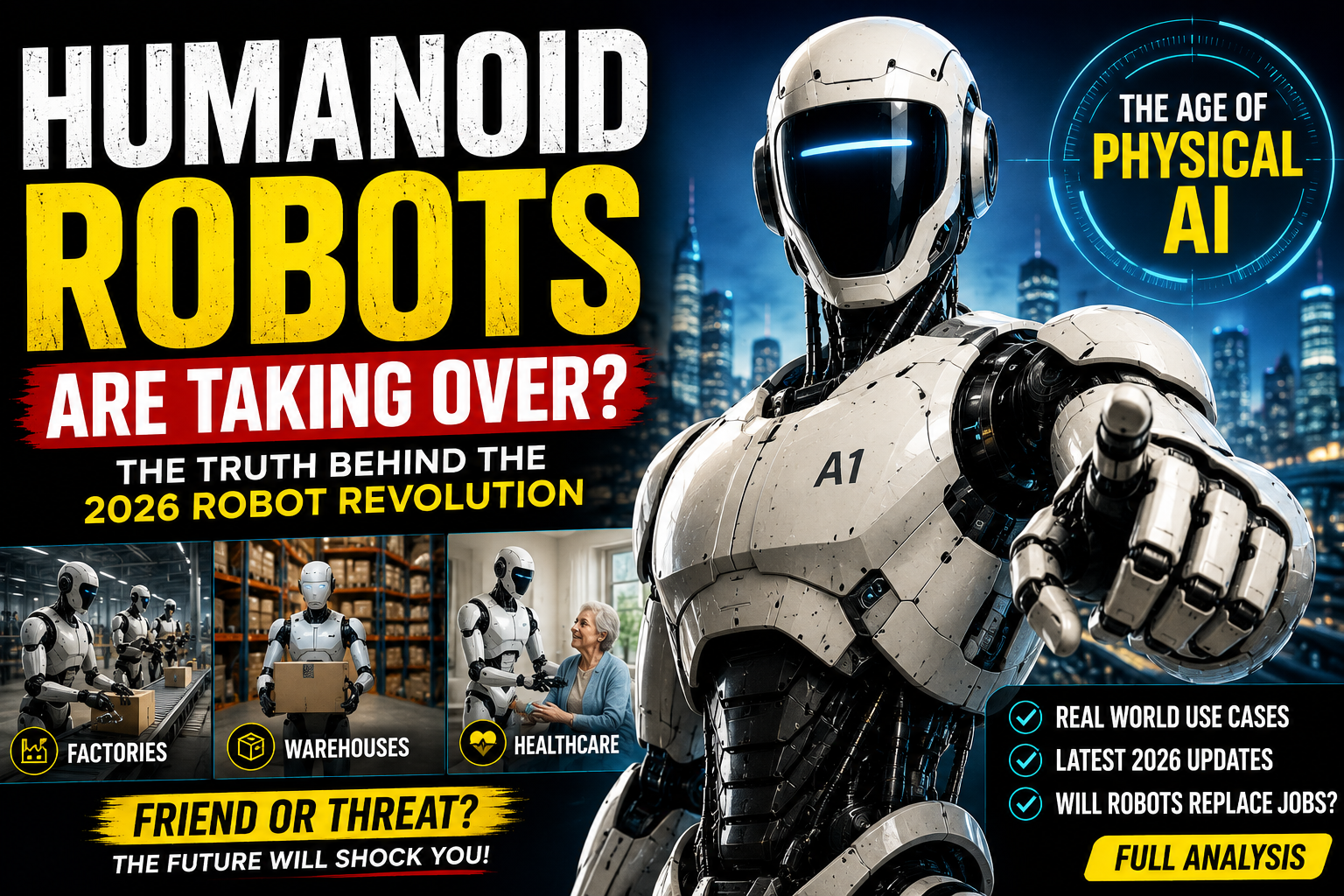
Humanoid robots have officially entered the spotlight.
For years, robots were mostly associated with science-fiction movies, research laboratories, and highly specialized factory machines. But in 2026, something has changed. Humanoid robots are becoming faster, smarter, cheaper, and increasingly capable of interacting with the real world.
The latest developments are difficult to ignore.
At the 2026 World Humanoid Robot Games in Beijing, more than 2,000 humanoid robots competed in events including running, soccer, table tennis, boxing, and practical tasks. One robot, Tiangong Ultra, eventually completed the 100-meter sprint in just 8.64 seconds—faster than Usain Bolt’s human world record of 9.58 seconds.
But here’s the important question:
Are humanoid robots actually ready to take human jobs, or are we watching an impressive technological show that is still years away from becoming truly useful?
The answer is much more complicated than the viral videos suggest.
What Is a Humanoid Robot?
A humanoid robot is a machine designed to resemble the basic physical structure of a human being.
That usually means two arms, two legs, a torso, a head, cameras or other sensors, and software that allows the robot to understand its surroundings and perform physical actions.
The reason companies are interested in humanoid designs is simple: the world is already designed for humans.
Doors have handles.
Stairs are built for two-legged movement.
Factories contain tools designed for human hands.
Homes contain kitchens, shelves, washing machines, furniture, and thousands of objects that humans can easily manipulate.
Instead of rebuilding the entire environment for a specialized robot, a humanoid could theoretically operate within the environment that already exists.
That is the long-term vision.
The Difference Between Traditional Robots and Humanoid Robots
Traditional industrial robots are extremely good at specific tasks.
A robotic arm on a factory production line can repeatedly weld, paint, assemble, or move an object with incredible precision.
In many situations, these machines are actually much better than humanoid robots.
So why build a robot that looks like a human?
Because humanoids are intended to be general-purpose machines.
A traditional robotic arm might be excellent at welding but completely useless at opening a door.
A humanoid could potentially walk to the door, open it, enter another room, pick up a box, carry it somewhere else, and perform another task.
That flexibility is the real prize.
The goal isn’t simply to build a stronger robot.
The goal is to build a robot that can learn how to perform many different tasks without requiring a completely new machine for every job.
The “Physical AI” Revolution
This is where artificial intelligence becomes extremely important.
A humanoid robot needs more than motors and mechanical joints.
It needs a brain.
Researchers increasingly refer to this concept as embodied AI or physical AI—AI systems that can perceive the physical world, make decisions, and act through a machine.
A chatbot can understand the sentence:
“Pick up the red cup.”
But a robot has to solve a much harder problem.
It must identify which object is the red cup, determine where it is located, move its body toward it, position its hand correctly, understand how much force to use, grab the cup without dropping it, and then move it somewhere else.
Every step involves uncertainty.
The cup could be slippery.
The lighting could change.
Another object could be blocking it.
The cup could be slightly different from the examples used during training.
This is why physical AI is much more difficult than simply generating text.
Robots Are Getting Shockingly Good at Movement
The recent robot competitions in Beijing demonstrated just how quickly hardware is improving.
More than 2,000 robots participated in the 2026 World Humanoid Robot Games, with competitions ranging from athletics to simulated workplace activities.
The most spectacular achievement came from Tiangong Ultra.
The robot improved its 100-meter performance throughout the competition and ultimately recorded an 8.64-second time.
That is an extraordinary demonstration of mechanical control, balance, motors, batteries, sensors, and software working together.
But there is an important catch.
Running fast in a controlled environment is not the same thing as doing useful work.
And this distinction could determine the future of the entire humanoid robotics industry.
The Problem With Viral Robot Videos
Social media has made humanoid robots look almost magical.
We see robots dancing.
Robots performing kung fu.
Robots running.
Robots playing soccer.
Robots doing backflips.
These demonstrations are impressive, but they don’t necessarily prove that robots are ready for everyday employment.
Real workplaces are unpredictable.
A factory worker may need to deal with a damaged package, a misplaced object, changing lighting, a wet surface, an unexpected machine failure, or a task that wasn’t included in the training data.
A robot needs to handle those situations without constant human intervention.
That is much harder.
Reuters recently reported that China’s humanoid robotics industry has made major hardware progress but still faces significant problems with intelligence, reliability, cost, and real-world adaptability. Some robots remain dramatically slower than humans when performing practical tasks.
In other words:
A robot that can win a race isn’t necessarily a robot that can work an eight-hour shift.
The Biggest Problem: The Robot Brain
Building the body is only half the challenge.
The bigger problem may be the software.
Humanoid robots need AI systems capable of connecting perception with physical action.
They must see something and understand what it means.
Then they must decide what to do.
Then they must move their bodies accordingly.
This requires enormous amounts of real-world training data.
A language model can learn from millions or billions of pieces of text available digitally.
Robots don’t have an equivalent supply of high-quality physical-world data.
A robot needs to experience objects, environments, movements, failures, surfaces, lighting conditions, human behavior, and countless other variables.
This is one reason companies are investing heavily in robot training facilities and real-world deployments.
The more robots operate in the real world, the more data developers can potentially collect.
And the more data they collect, the better future robots could become.
China Is Betting Big on Humanoid Robots
China has emerged as one of the world’s most aggressive players in humanoid robotics.
More than 150 Chinese companies are reportedly working on humanoid robots, while government investment and procurement are helping accelerate development. Reuters reported that Chinese government entities spent at least $230 million on humanoids and related systems during the first half of 2026.
Chinese manufacturers also dominate current humanoid shipments.
Companies such as Unitree, UBTech, and others are pushing rapidly into the market.
The strategy resembles China’s earlier approach to industries such as electric vehicles and solar technology:
Invest heavily.
Build manufacturing capacity.
Reduce component costs.
Create competition.
Collect data.
Improve the technology.
Then scale globally.
Whether this strategy will succeed in humanoid robotics remains uncertain.
But the scale of the investment is undeniable.
Unitree and the Search for a “ChatGPT Moment”
One of the most interesting developments is the idea that robotics could eventually experience its own equivalent of the ChatGPT breakthrough.
Unitree CEO Wang Xingxing recently described the industry as approaching a potential “ChatGPT moment” for embodied intelligence, while acknowledging that humanoid robots are not yet ready for mass deployment. Other industry leaders have suggested that a major breakthrough could arrive later this decade.
The comparison is important.
Before ChatGPT, many people knew about AI.
But ChatGPT made interacting with AI dramatically easier and more useful for ordinary users.
Robotics could experience a similar transformation if researchers develop a system capable of understanding natural-language instructions and reliably performing a wide range of physical tasks.
Imagine saying:
“Clean the kitchen.”
And the robot actually understands what that means.
It identifies dishes.
Moves them to the sink.
Wipes the counter.
Puts objects away.
Throws away garbage.
And adapts when something unexpected happens.
That would represent a true revolution.
Could Humanoid Robots Replace Human Workers?
Eventually, they might replace some tasks.
But the timeline is uncertain.
The first major applications are likely to involve environments where work is repetitive, dangerous, physically demanding, or difficult to staff.
Factories are an obvious example.
Warehouses are another.
Hospitals, logistics centers, mines, construction sites, laboratories, and hazardous environments could also benefit.
But replacing an entire human worker is much more difficult than automating one task.
A human employee can perform dozens of different activities during a workday.
A robot may be extremely good at one task and terrible at another.
Therefore, the early stage of the robotics revolution will probably involve task automation rather than complete job replacement.
A factory might employ humans alongside robots.
Humans handle unpredictable situations.
Robots handle repetitive physical work.
Over time, as robot intelligence improves, that balance could change.
What About Robots in Our Homes?
This may ultimately be the biggest market.
Imagine having a humanoid robot at home that can perform everyday chores.
It could potentially:
- Pick up objects.
- Load a dishwasher.
- Fold clothes.
- Clean rooms.
- Carry groceries.
- Prepare simple meals.
- Assist elderly people.
- Move heavy objects.
- Perform household maintenance.
This sounds like science fiction.
But the basic idea is technically plausible.
The challenge is reliability.
Nobody wants a household robot that works perfectly 90% of the time and destroys something expensive during the other 10%.
Home environments are also much more complicated than factories.
Every house is different.
Objects are constantly moved.
Children and pets move unpredictably.
Floors can be slippery.
Rooms can become cluttered.
A useful home robot must be extremely adaptable.
The Price Problem
Even if humanoid robots become technically capable, there is another question:
Will people be able to afford them?
The industry is aggressively working to reduce costs.
As production increases, components such as motors, batteries, sensors, cameras, actuators, and computing hardware can become cheaper.
But building a sophisticated humanoid robot remains expensive.
Reuters reported that prices are already falling in China’s rapidly expanding robotics market, while analysts expect further reductions as manufacturing scales.
If humanoid robots eventually reach the price range of a car—or even lower—the market could change dramatically.
But if they remain extremely expensive, adoption may stay limited to factories, corporations, governments, and research institutions.
The Hidden Danger: Security
There is another issue that doesn’t receive enough attention.
Humanoid robots are connected computers with physical bodies.
That creates a new category of cybersecurity risk.
Imagine someone remotely taking control of a robot inside a warehouse.
Or compromising a home robot.
Or manipulating its AI instructions.
Or accessing the cameras and microphones inside a household.
The more powerful robots become, the more important security will become.
A compromised chatbot may produce a dangerous answer.
A compromised physical robot could potentially cause physical damage.
Therefore, future robotics systems will need extremely strong security, authentication, access controls, and safety mechanisms.
Are We Really Entering the Robot Age?
Yes—but probably not in the way science fiction predicted.
We are unlikely to wake up tomorrow and find millions of humanoid robots replacing every human worker.
The transition will probably be much slower.
First, robots will perform carefully selected tasks.
Then companies will expand their responsibilities.
AI models will improve.
Training data will increase.
Hardware will become cheaper.
Battery technology will improve.
Sensors will become more capable.
Eventually, robots could become flexible enough to perform a wide variety of jobs.
The important question isn’t whether humanoid robots are coming.
They are.
The real question is how quickly their intelligence catches up with their physical abilities.
Final Thoughts
The humanoid robot revolution is one of the most fascinating technology stories of 2026.
The machines can already perform movements that would have seemed impossible a decade ago.
They can run.
They can balance.
They can manipulate objects.
They can compete in sports.
They can interact with humans.
And researchers are increasingly connecting these machines to advanced AI systems designed to understand and operate in the physical world.
But we should be careful about confusing impressive demonstrations with true autonomy.
The real test won’t happen on a stage.
It will happen in factories, warehouses, hospitals, homes, restaurants, farms, and construction sites.
When a humanoid robot can arrive at work in the morning, receive a general instruction, understand its environment, perform useful tasks for hours, recover from unexpected problems, and safely work alongside humans without constant supervision—that will be the real breakthrough.
Until then, the robot revolution is still being built.
But judging by what happened in 2026, the future may be arriving faster than many people expected.

Leave a Reply