AI Hallucinations Explained: How to Check Whether an AI Answer Is True
Understand why AI assistants sometimes invent facts, sources or details, and learn a practical verification workflow before using their answers.
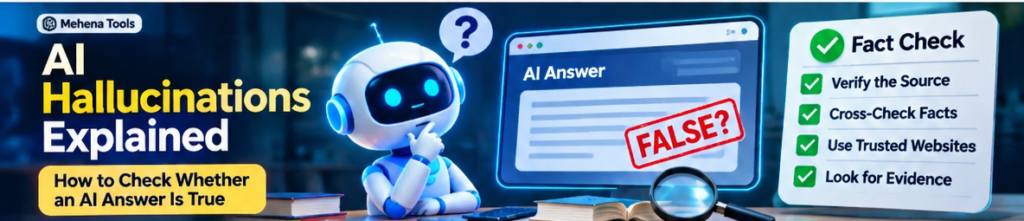
An AI assistant can produce a polished paragraph, a convincing explanation and a list of references in seconds. Yet some details may be wrong. A date can be invented, a quotation misattributed, a legal rule described incorrectly or a source listed that does not support the claim. This behaviour is commonly called an AI hallucination.
Understanding hallucinations is essential for anyone using AI for study, research, business, writing or daily decisions. The central lesson is simple: a confident answer is not proof. Treat AI output as a starting point that needs checking.
What Is an AI Hallucination?
An AI hallucination occurs when a model generates information that appears plausible but is unsupported, inaccurate or inconsistent with the available facts. The response may sound natural because language models are designed to generate likely sequences of text. That does not mean the model has independently verified every statement.
Hallucinations can take several forms. An assistant may invent a statistic, provide a false explanation, combine facts from different events, misstate a product feature or create a citation that looks genuine. Sometimes the error is subtle: the main idea is correct, but a date, condition or exception is missing.
Why Do AI Systems Produce Incorrect Answers?
1. Language generation is not the same as fact verification
A language model generates responses based on patterns learned during training and the information available in the current interaction or connected sources. Unless a system is specifically grounding its answer in verified material, it may produce a plausible continuation rather than retrieve a confirmed fact.
2. The question may contain missing context
Questions such as “What is the latest rule?” are incomplete without a country, authority, date and subject. The assistant may silently assume the wrong context. Ask it to identify assumptions or request clarification when the answer depends on jurisdiction or time.
3. Information may be outdated
Policies, prices, software interfaces, laws and product features change. A model may provide information that was once correct but is no longer current. For time-sensitive topics, check the official source and its publication or update date.
4. The model may try to fill gaps
If a document does not contain an answer, an AI system may still attempt to complete the response. This is especially risky when extracting information from tables, contracts or long reports. Tell the system to write “not stated in the source” rather than guessing.
Common Examples of Hallucinations
- Invented citations: A book, paper or website is named, but it cannot be found or does not support the claim.
- False statistics: A percentage or survey result is presented without a verifiable source.
- Incorrect summaries: A report’s limitation or exception is omitted, changing its meaning.
- Made-up features: An AI assistant claims that an application supports a function that it does not offer.
- Confused identities: Two people, organisations or events with similar names are mixed together.
A Practical Five-Step Verification Method
Step 1: Break the answer into checkable claims
Do not verify a long response as one unit. Separate it into individual statements: dates, names, numbers, definitions, product claims and recommendations. A response may contain several accurate points and one important false statement.
Step 2: Ask for the original source
Request the official document, research paper, government page or product documentation behind a claim. A link alone is not enough. Open it and check that the page exists and actually supports the statement.
Step 3: Prefer primary sources
For a law or public policy, look for the relevant government department or official legal publication. For a software feature, use the developer’s documentation. For a scientific claim, look for the original study or a trusted scientific institution. Secondary articles can provide context, but the original source is usually better for checking the exact wording.
Step 4: Check dates, definitions and limitations
Confirm when the source was published or updated. Read the surrounding paragraph, not just a search snippet. Check the population, location, sample size, units and conditions behind statistics. A number without context can be misleading even when copied correctly.
Step 5: Compare independent reliable sources
For important claims, seek confirmation from another credible source. Two websites repeating the same press release are not necessarily independent confirmation. Look for different primary or authoritative sources where possible.
Prompts That Can Reduce Guessing
Clear instructions can encourage an AI assistant to handle uncertainty more carefully. They do not guarantee correctness, but they make the expected behaviour explicit.
Answer only from the material I provide. If the answer is not stated, write “Not stated in the source.” Do not infer missing dates, names or numbers. For each factual statement, identify the exact passage that supports it.
List the five most important factual claims in your answer. Mark each as verified from the supplied source, an inference, or unverified. Do not invent citations or URLs.
This question depends on current information. Identify the official authority and the date of the latest source you used. If you cannot access a current official source, say so clearly.
When Hallucinations Matter Most
Extra care is necessary in medicine, law, finance, employment, education assessments, cybersecurity and safety instructions. A wrong answer in these areas can cause real harm. Use AI to prepare questions, organise information or understand terminology, but rely on qualified professionals and authoritative documents for decisions.
When using AI to review a contract or financial document, do not let a summary replace the original. When preparing educational material, verify formulas, definitions, dates and answer keys. When dealing with security, follow the official guidance of the relevant service or authority.
Can AI Detectors Identify Hallucinations?
AI-content detectors and fact-checking tools solve different problems. A detector that estimates whether text was generated by AI does not establish whether its facts are true. A fact-checking workflow must examine evidence, source quality and context. Do not treat a detector score as proof that a statement is accurate or false.
Frequently Asked Questions
Are hallucinations always completely false?
No. A response may mix correct information with unsupported details. Check individual claims rather than labelling the entire answer accurate or inaccurate.
Can a better prompt eliminate hallucinations?
No prompt can guarantee zero errors. Clear instructions, source-grounded questions and explicit uncertainty rules may reduce some mistakes, but verification remains necessary.
Why does AI invent references?
When asked for citations, a model may generate reference-like text that fits the topic. Always open the source and confirm its title, author, date and relevance.
What should I do if an AI answer has no source?
Ask for the evidence and independently search for an authoritative source. If the claim cannot be verified, do not present it as fact.
Final Checklist
- Have I separated the response into factual claims?
- Does each important claim have a real source?
- Does the source directly support the claim?
- Are dates and rules current for my location?
- Have I checked numbers, units and exceptions?
- Have I labelled uncertainty instead of hiding it?
AI can make research faster, but speed is valuable only when the result is dependable. Build the habit of checking evidence before sharing or acting on an answer.
Further Reading
Find simple browser-based utilities for everyday document and image tasks.
Explore all tools →